



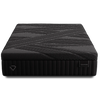
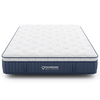

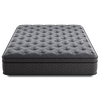

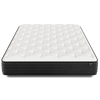
Nested Pocketed Coils
More coils. Tighter spacing. Support that follows your body.
Nested pocketed coils take the same individually wrapped springs and arrange them in a honeycomb pattern — each coil tucked into the gap between the coils around it instead of sitting in a straight grid. Nesting them this way removes the empty space a standard row-and-column layout leaves behind, so more coils fit into the same mattress and every part of your body has a spring directly beneath it. The result is a surface that feels quietly denser and more responsive: it reads the small contours a wider grid would bridge over, cradles the shoulders and hips, and keeps the lumbar area from dipping. More points of contact also mean motion has fewer places to travel, so the bed stays still on your side when your partner moves on theirs — and the extra coil count adds durability, because the load is shared across more springs instead of concentrated on a few.
See It in Action
Nested vs. Regular Pocketed Coils
Same demo shown on our in-store foam cube wall.
Features & Benefits
| Feature | What It Means for You |
|---|---|
| Honeycomb (nested) coil layout | Coils sit in the gaps between each other, eliminating the dead space of a straight grid |
| Higher coil count in the same space | More springs under you means support is read in finer detail, not averaged across a wider grid |
| More contact points per square inch | Closer contouring at the shoulders and hips with the lumbar area held level |
| Enhanced motion isolation | Movement has fewer paths to travel through, so a partner's motion stops sooner |
| Load shared across more coils | No single spring carries the weight, so the system resists body impressions over time |
| Individually pocketed, heat-tempered steel | Each coil still works alone and holds its resilience for the life of the mattress — engineered in-house by Diamond |
Common Questions
What does "nested" mean?
Rather than sitting in straight rows and columns, nested coils are staggered so each coil tucks into the gap between the ones around it — like a honeycomb instead of a grid. That removes the dead space a standard layout leaves behind and lets more coils fit into the same mattress.
Do more coils mean a firmer bed?
Not necessarily. A higher coil count means more points of contact, which gives the surface a denser, more responsive feel — but firmness is determined by the coil gauge and the comfort layers above, not by how many springs are in the bed.
How does this compare to regular pocketed coils?
Regular pocketed coils sit in a straight grid, which leaves gaps where there is not a spring directly beneath your body. Nested coils fill those gaps, so support is more consistent, contouring is more precise, and motion has fewer paths to travel across the bed.
